


.png?width=274&height=200&scale=canvas)


.png?width=500?width=274&height=200&scale=canvas)

.png?width=274&height=200&scale=canvas)

.png?width=274&height=200&scale=canvas)

Kingston USB Group Test - SE9 v SE9G2 v Micro3.1
August 30, 2021 by Matt Rees
USB sticks are everywhere. Small and reliable yet capable of holding huge amounts of data, almost everyone who owns a computer will have one, and most people who use computers daily in their jobs will have several.
With their increase in popularity over the last 10 years, almost every technology company out there produces some form of USB stick. Whilst this has had the positive effect of knocking the pricing down, it adds a problem in that there is just so much choice! What brand of USB stick do you choose to hold your important data safely? Today we're looking at Kingston Technology and their DataTraveler SE9/Micro range of USB sticks.
Kingston have been in the memory game since 1987, where they entered the market with a memory module to replace surface-mounted memory chips. Since then they've grown into the world's largest independent manufacturer of memory products, with RAM, memory cards, SSDs and more all part of their product portfolio.
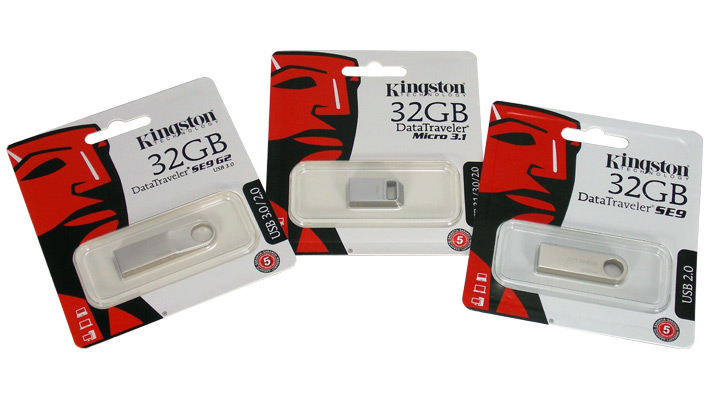
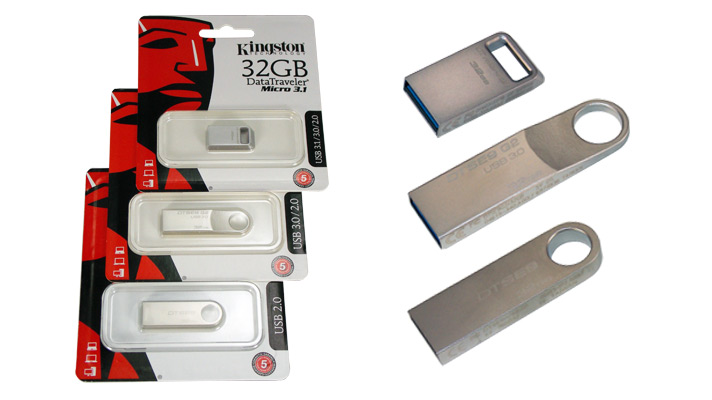
Above we have the three variants of Kingston's DataTraveler SE9/Micro series - The SE9, SE9 G2 and Micro 3.1. Each uses a stylish metal casing, with a decent sized hole in the chassis so you can attach them to your keyring. Their small size make them ideal for Ultrabooks and Tablets, especially the Micro which is really quite tiny. Thankfully the metal casing means they're very sturdy, and Kingston is confident enough in their reliability to provide a five-year warranty too.
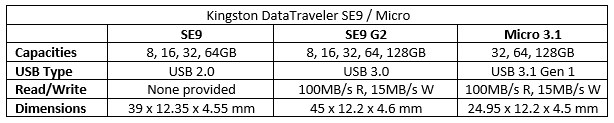
Let's take a quick look at the specifications:
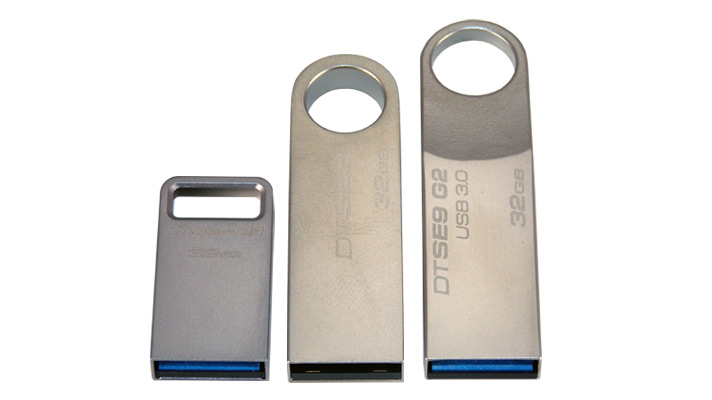
Physically there isn't too much of a difference between the SE9 and SE9 G2 - their thickness and height are almost identical, with the SE9 G2 being half a centimetre longer. The Micro 3.1 though is really tiny and is really ideal for portable devices.
There is an odd anomaly here in that Kingston list the Micro USB 3.1 as having similar read/write specs to the SE9 G2, despite the fact it is a USB 3.1 device. Upon close inspection it's actually listed as USB 3.1 Gen 1... Gen 1?
Confused? So was I, so after doing a bit of research I found that there are two generations of USB 3.1. Generation 2 is the super-fast new specifications with a theoretical 10Gbps bandwidth, but Generation 1 is actually just merged with USB 3.0. This is why the transfer rates don't look any different - the drive is no faster than a normal USB 3.0 drive.
This isn't Kingston's fault however. It appears that this has been retroactively added to the USB 3.0 specs, so all new products that are USB3.0 should also begin stating USB 3.1 Gen 1 - it will just take time for that to filter down to retail. Even the USB3.1 Macbooks with the Type-C connector state USB 3.1 Gen 1, so they're just normal USB 3.0 ports. I must admit it's a really confusing change though.
So, on to drive tests. I took each drive and benchmarked them using UserBenchmark using a native USB 3.0 port (no need for 3.1 as noted previously) to see whether they reached the speeds you would expect based on Kingston's data.
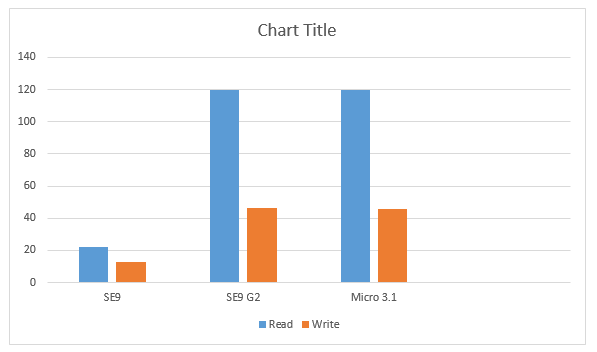
As you can see, the USB 2.0 drive is significantly slower, although to be honest it's relatively poor by USB 2.0 standards. The USB 3.0 drives actually perform better than Kingston specify, with both drives averaging 120MB/s read speeds and over 45MB/s write (with the SE9 G2 ever so slightly out performing the Micro 3.1. As expected, as the Micro drive is USB 3.1 Gen 1, it performed no better than the SE9 G2.
The Kingston DataTraveler range is pretty good value for money. Whilst not the fastest drives available, they are certainly of a high quality physically, being extremely sturdy and resistant to damage thanks to their metal casing.
You can take a look at these and more of the Kingston USB memory stick range below:
https://www.cclonline.com/category/724/Storage/USB-Memory-Sticks/manufacturerslist/37/

Our Choose Your Own Case option gives you expert-spec'd internals with the freedom to pick the chassis that fits your setup—so your next PC performs brilliantly and looks exactly how you want it.
AMD has done the unthinkable — stacked 3D V-Cache on both chiplets — and the Ryzen 9 9950X3D2 Dual Edition is the result: a chip built for gamers, creators, and developers who want the full scope of PC processing possibilities.

PRAGMATA is almost here: Why Palit RTX 5070 GPUs are the smart upgrade
Elevate your rig with the Palit RTX 5070 GPU. PRAGMATA is almost here, and the smart upgrades begin now!

Stop waiting — Why now is the right time to buy an NVIDIA RTX 50-series GPU
Upgrade with confidence using NVIDIA’s RTX 50 Series. Discover Blackwell architecture, DLSS 4 performance gains, improved efficiency, and why now—not later—is the best time to invest in a future-ready GPU.